
Why you stopped
Two beliefs, and they're both wrong.
The first is that silence is a no. It almost never is. Think about who's actually requesting a move out clean. That person is in the middle of moving house, which is one of the most chaotic fortnights a human being goes through voluntarily. They are not sitting quietly evaluating your proposal. They meant to reply and then a van didn't show up and the landlord called and it's now Thursday.
The second belief is that chasing makes you look desperate. It can, if you send the same message four times. It doesn't if each one hands the person something they didn't have before. There's a real difference between following up and nagging and it comes down entirely to whether the message contains information.
About the statistics you'll find on this
Search this and you'll hit confident claims that eighty percent of sales need five follow ups, or that nearly half of salespeople give up after one. I went looking for the primary source on those and couldn't find one that held up. The versions in circulation don't even agree with each other on the numbers.
So I'm not going to quote them at you. What's below comes from how people actually buy cleaning services, not from a statistic I can't stand behind. Test it against your own close rate and adjust.
The sequence
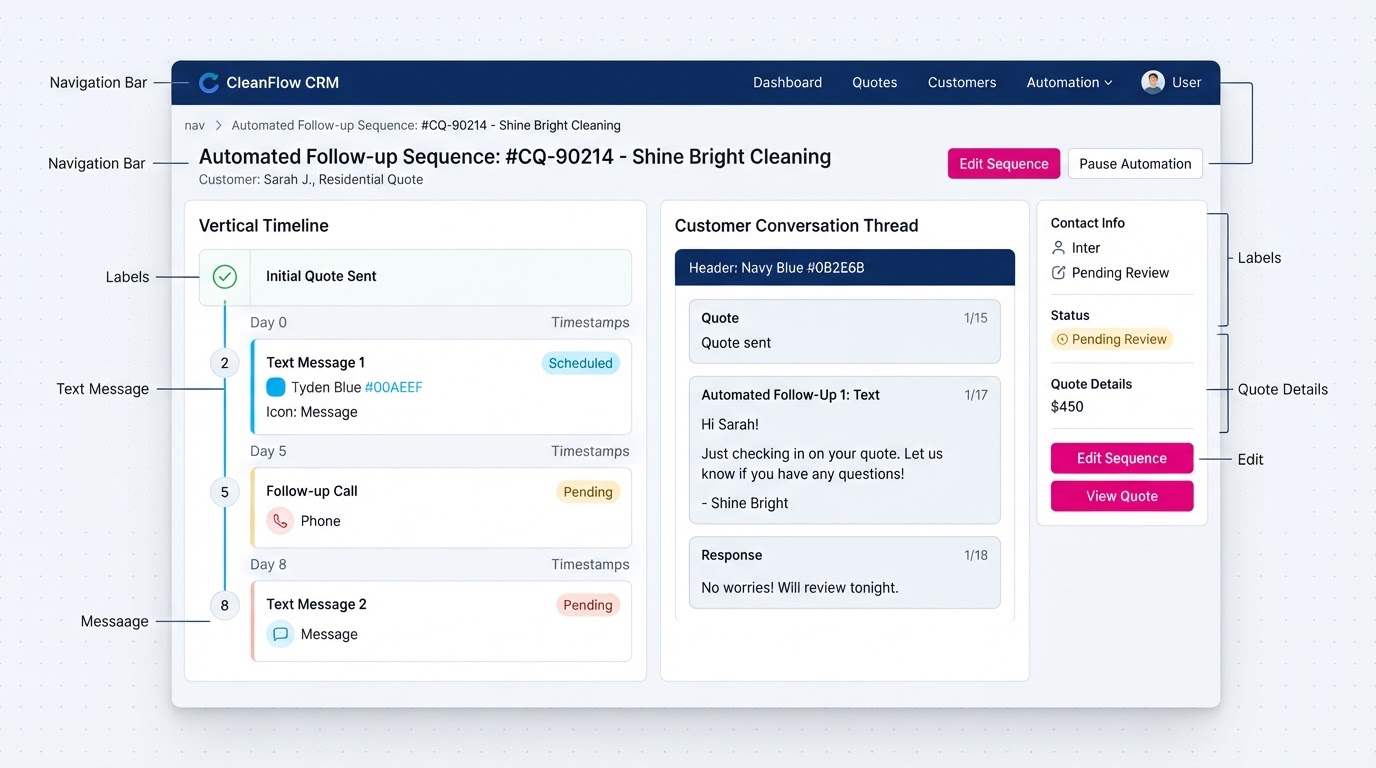
Same day, by text
Send the quote in writing, then text to confirm it landed. This isn't really a follow up, it's closing the loop on the quote, and it matters because an emailed estimate can sit unopened for a week behind a wall of promotional mail.
Keep it short. Price, one line on scope, and a question about timing rather than a question about whether they want it. Asking when suits you gets more replies than asking would you like to proceed.
Two days later, by text
This one carries new information, and the easiest new information you have is your own calendar. Tell them what's still open in the week they mentioned.
Something like: still got Thursday morning and Friday afternoon open next week if either of those work. That's a real message with a real fact in it. Just checking in is not.
Five to seven days out, by phone
One call, and pick up the phone properly rather than hiding behind text. If it goes to voicemail leave something short and then follow it with a text, because hardly anyone listens to voicemail anymore.
You're not calling to close. You're calling to find out what's going on, and the answer is usually something you can fix. They wanted weekly not biweekly. They're waiting on a closing date. They got a quote for $180 and yours was $245 and they don't understand why. None of those are dead. All of them look exactly like silence from where you're sitting, which is the whole problem with not calling.
Around two weeks, then stop
One clean exit message. You'll leave it there, the price stands, text whenever they're ready.
This one converts more often than people expect, because it takes all the pressure off and some folks were genuinely just waiting for a moment when replying didn't feel like a commitment. It also ends the sequence deliberately rather than letting it trail off, which matters for your own head as much as anything.
The rules for every message
Something new in each one. Availability, a scheduling option, a note about their property type, anything that isn't a restatement of the quote.
A question they can answer in four words while standing in a grocery line. Not a request for a decision.
And don't apologize. Sorry to bother you is the worst opening line in sales. You quoted a job somebody asked you to quote. Following up on it is the job, not an imposition.
When to stop chasing and start nurturing
After four touches, end the active sequence. Do not delete the lead. Deleting the lead is the actual mistake here.
Cleaning is one of those services where no usually means not yet. The person who couldn't afford it in March calls in September when the new job starts. The move out clean that fell through because the sale collapsed comes back the following spring. The office manager who went with the cheaper company calls you eight months later when that company stops turning up, and by then price is no longer the thing she cares about.
Put those leads on a long term list and contact them occasionally with something worth reading rather than another sales pitch. Once a quarter is plenty. It costs you almost nothing and a surprising share of revenue eventually walks in through that door.
Commercial is different
Everything above assumes residential or small commercial. Bigger janitorial contracts run on a completely different clock and if you chase them like a house clean you'll burn the relationship.
Those decisions involve several people, usually hinge on an existing contract end date, and can sit dead still for months for reasons that have nothing whatsoever to do with you or your price. Follow up less often, over a much longer horizon, and ask about their current contract end date in the first conversation. That date is the only timeline that matters and most people will just tell you if you ask.
Doing this without having to remember
None of the above is hard. It's hard to keep doing on a Thursday in August when you've cleaned four houses and your back hurts, which is why most owners run the sequence for three weeks and then quietly stop.
Tyden runs quote follow up off your pipeline automatically, so it fires whether or not you thought about it and stops the second somebody replies or books. Lost lead reactivation handles the long term list.
Follow up automation is on all three packages. Foundation at $97 a month plus $147 activation covers core follow up workflows. Growth at $397 a month plus $797 activation adds stronger follow up, review and reputation workflows, reactivation, and AI Employee Unlimited under fair-use terms, with Voice AI and Conversation AI enabled and no monthly minute or response caps. Front Office at $697 a month plus $1,497 activation adds advanced routing and escalation, broader reactivation and reporting, and carries the same AI Employee Unlimited tier as Growth, plus a monthly performance call and up to two workflow changes a month. Annual prepaid waives activation on all three.
This is the third post in our series on estimates and quote follow-up. Post 1 covers the full estimate process from inquiry to close, and Post 2 gets into how fast you should respond to a cleaning lead.