Your pricing is probably fine
Ask a cleaning owner about their estimate process and you'll get a lecture on pricing. Square footage, bedrooms and baths, whether there's a dog, how bad the kitchen is, what the crew costs per hour, what the drive time does to the margin on the far side of town.
Fine. You've priced a thousand houses and you're close to right on most of them. Pricing is not where you're losing money.
The estimate is everything wrapped around that number. Somebody raises their hand. You get back to them, or you don't. You find out enough to price the job. You send the number. And then, usually, nothing happens, and three weeks later you couldn't tell anyone whether that person hired a competitor, decided to keep cleaning their own house, or just never saw the email.
That last part is the expensive part, and almost nobody measures it.
Stage one: catching the inquiry at all
Cleaning leads show up in more places than almost any other trade. The business line. The contact form. Facebook Messenger. An Instagram DM. A text to your personal cell because someone got your number from a neighbor. A comment on a Nextdoor thread you weren't watching. The lady at church.
The first problem isn't that you're slow. It's that there's no list. You can't follow up on something you can't find, and if an inquiry only exists in a notification you swiped away at a red light, it's gone.
Get every channel landing in one place before you try to fix anything else in this article. Everything below assumes you can see all your leads in one view.
Stage two: how long the person waits
Here's where most of the money goes.
The research everybody quotes comes from Dr James Oldroyd at MIT's Sloan School of Management, working with InsideSales.com back in 2007. They looked at more than fifteen thousand leads and over a hundred thousand call attempts across six companies. Calling a web lead at thirty minutes instead of five cut the odds of qualifying it by a factor of twenty one. The odds of reaching the person at all dropped by a factor of a hundred.
A Harvard Business Review study four years later audited 2,241 US companies and found the median first response was forty two hours. Drift later looked at 433 companies and got forty seven, with only seven percent answering inside five minutes.
Now, those were B2B sales studies. Nobody has run that experiment on somebody requesting a move out clean, so don't take twenty one as gospel for your business. What transfers is the shape of the curve, and the shape is brutal. Value falls off a cliff in the first half hour and keeps sliding. A lead you answer in four minutes and the same lead you answer tomorrow morning are two different leads. The second one has already talked to two of your competitors and formed an opinion about both.
Post 2 in this series gets into what a realistic response standard looks like when you're inside someone's house with a vacuum running for six hours a day.
Stage three: the walkthrough, or not
Some jobs you can price on the phone in four minutes. Standard recurring residential, usually yes. Post construction, move out, apartment turns, anything commercial, usually no.
Decide up front which services need eyes on the property and build two separate paths, because running everything through a site visit will wreck your calendar and pricing everything by phone will eventually hand you a post construction job you quoted like a deep clean. We have all done that one.
For the jobs that do need a visit, you've now created a second conversion problem, because a walkthrough nobody shows up for costs you a morning and a tank of gas and tells you nothing. Post 4 deals with that.
One thing regardless of which path you use. Put the number in writing, same day, with the scope spelled out in plain language. A price said out loud in a hallway is not a quote. It's a conversation that you and the customer will remember completely differently in six weeks when the invoice arrives.
Stage four: following up, which you're not doing
I'll be blunt. This is the cheapest revenue available to you and most cleaning companies leave it sitting there.
The quote goes out. Two days pass. You think about texting them, then you decide you don't want to seem pushy, and the lead goes cold in complete silence. Nobody ever says no. They just stop existing.
Three or four touches over two weeks, mixed between text and one actual phone call, will beat a single follow up by a margin that surprises people the first time they measure it. And it costs you nothing except doing it every single time instead of when you happen to remember. Post 3 covers what to say.
Stage five: the close, and the ten minutes right after it
For a cleaning company the close isn't really the finish line, because a one time job and a recurring client are wildly different animals financially.
Run the math once and it changes how you think. A one off deep clean at $300 is worth $300. The same customer on biweekly at $150 is worth roughly $3,900 a year, plus whatever referrals come out of them, plus a review that helps you rank. Same person. Thirteen times the value.
Which makes the ten minutes after a successful first clean the single highest leverage moment in the whole business. The house looks incredible, the customer is standing there genuinely pleased, and this is when you ask about putting them on the schedule regularly. This is also when you ask for the review.
Neither conversation gets easier a week later. It gets considerably harder, and most owners have it never.
Find your own leak
Pull last month and count four things. Inquiries in, across every channel. How many got any response and how quickly. How many turned into an actual quote. How many closed.
Gap between the first two numbers is a response problem. Gap between the last two is a follow up problem. Almost every owner who does this is convinced going in that they need more leads, and a good portion of them come out realizing they were already getting plenty and losing them somewhere in the middle. Which is good news, because fixing that is a lot cheaper than buying more leads.
Where Tyden comes into it
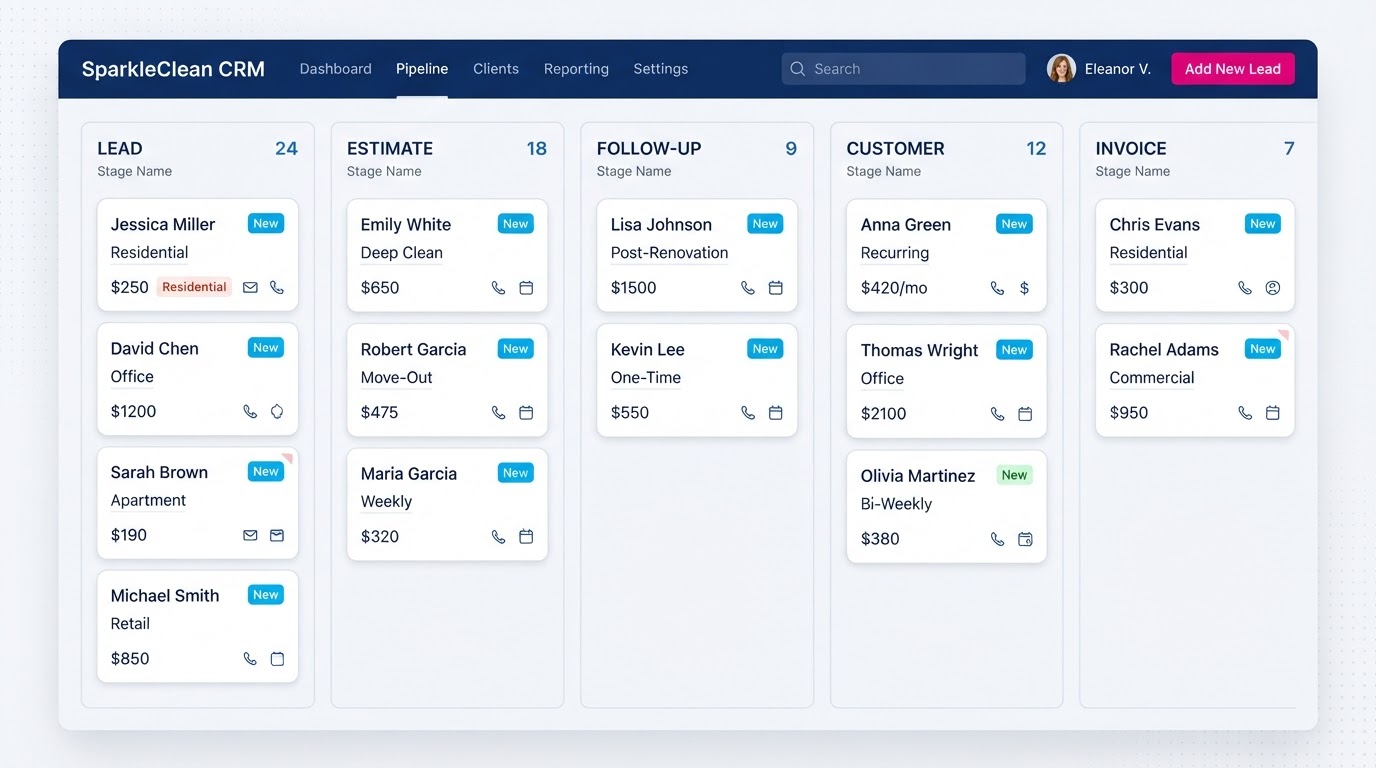
Tyden Solutions is a business operating system built for cleaning companies specifically, and this sequence is basically what it exists to run. Every channel lands in one CRM. Estimates and walkthroughs book onto a calendar with reminders already attached. Quote follow up fires on its own instead of depending on your memory at nine at night. Invoicing, review requests and recurring conversion all run off the same records.
Foundation is $97 a month plus $147 activation and covers the CRM, lead management, forms and web chat, booking, invoicing and core follow up, with no AI. Growth is $397 a month plus $797 activation, adding expanded automation, review and reputation workflows, reactivation, and AI Employee Unlimited under fair-use terms, with Voice AI and Conversation AI enabled and no monthly minute or response caps. Front Office is $697 a month plus $1,497 activation, with advanced routing and escalation, broader reactivation, reporting, a monthly performance call and up to two workflow changes a month.
Pay annually and activation is waived on all three.